
Healthy Aging: 5 Ways to Stay Strong & Independent After 60
Nobody walks into my office and says, “Doc, I’d like to live to 100.” What people actually say is, “I want to keep up with my grandkids.” “I want to stay in my house.” “I want to drive myself to my own appointments, thank you very much.”
With over fifteen years as an internal medicine physician, I’ve come to think that’s the smarter goal. Longevity is fine, but Quality of Life (QOL) is the goal and independence is the prize.
Here’s the part that surprises people: a big chunk of it is under your control, and it’s never too late to start. Not at 60, not at 75. Let’s talk about what actually works — the stuff with real evidence behind it, minus the supplement-aisle nonsense.
1. Lift something heavy. Yes, you.
If you take one thing from this article, make it this. Muscle is the currency of independence — it’s what gets you out of a chair, up the stairs, and back on your feet if you go down. We lose it steadily with age, but we do not lose it permanently.
A Cochrane review pooling more than 100 trials found that strength training in older adults produces large gains in muscle strength and real improvements in daily life: faster walking, easier stair climbing, and a much easier time getting out of a chair.3
Federal guidelines call for strength work at least 2 days a week plus about 150 minutes a week of moderate aerobic activity.1 2 Before you groan — that’s 22 minutes a day of brisk walking, the pace where you can talk but couldn’t comfortably sing. Lifting soup cans, resistance bands, and sitting-to-standing from your kitchen chair all count.
Start embarrassingly small.
Just start.
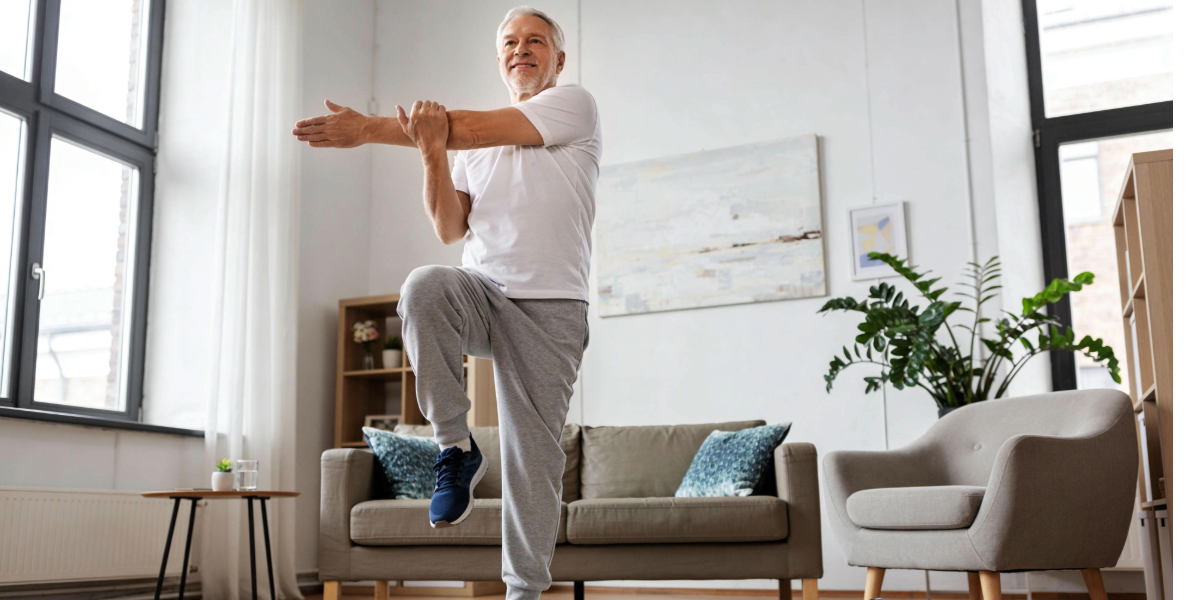
2. Don’t neglect your balance – falls are not “just part of getting older.”
More than one in four adults over 65 falls each year, and falls send about 3 million older Americans to the emergency room annually.4 One fall doubles the odds of another.
But this is not destiny — in 2024 the U.S. Preventive Services Task Force gave exercise programs a “B” recommendation for preventing falls in older adults at increased risk, which in guideline-speak means the evidence is genuinely good.5
The piece almost everyone skips is balance.
Stand on one foot while you brush your teeth.
Walk heel-to-toe down the hallway.
Try tai chi — it’s more effective than it looks and the class is usually a good time.
I recommend doing a walk-through of your house like a grumpy inspector: removing fall risks, such as loose rugs, dim stairwells, adding a grab bar in the shower.
Then get your medication list reviewed, because a surprising number of falls start in the pill bottle, not on the floor.
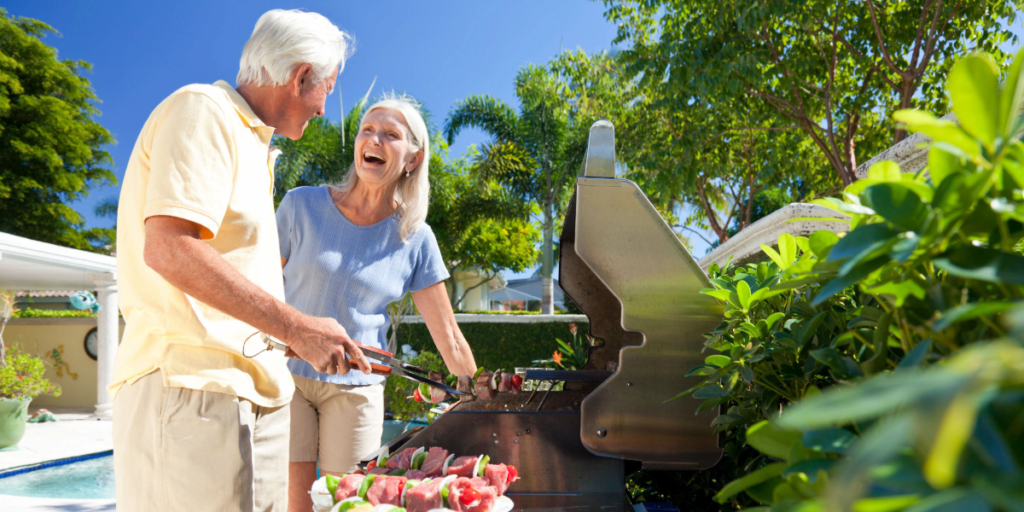
3. Eat more protein than you think you need.
The official recommended daily allowance (RDA) of 0.8 grams of protein per kilogram of body weight was designed for the average adult, and a large body of research — including the PROT-AGE6 7 expert consensus — suggests healthy older adults do better in the 1.0 to 1.2 g/kg range.
For a 160-pound person, that’s roughly 73 to 87 grams a day. The trick is spreading it out instead of dumping it all into dinner: eggs or Greek yogurt in the morning, beans or chicken at lunch, fish or lean beef at supper.
Protein and strength training are a package deal — one supplies the building materials, the other supplies the blueprint.
Around that, eat the pattern the cardiology literature keeps voting for: vegetables, fruit, beans, whole grains, nuts, olive oil, fish.
In San Antonio that’s easier than people assume — beans, avocado, grilled fish tacos, and a mountain of fajita veggies is a genuinely excellent dinner.
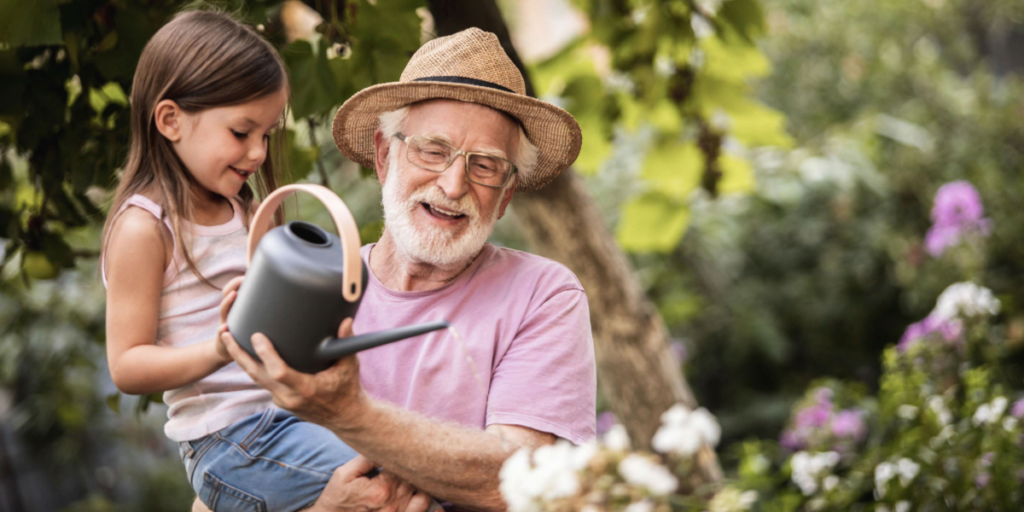
4. Your social calendar is a medical intervention.
I’m only half joking.
In 2024, the Lancet Commission concluded that up to 45% of dementia cases worldwide could potentially be prevented or delayed by addressing 14 modifiable risk factors — and several are squarely in play after 60: untreated hearing loss, untreated vision loss, social isolation, inactivity, high blood pressure, diabetes, and depression.8
This is exactly why I nag people about hearing aids instead of just turning up the TV. Hearing loss quietly pulls you out of conversations, then out of dinners, then out of your community.
The National Institute on Aging links social isolation and loneliness to higher rates of heart disease, depression, cognitive decline, and premature death.9 So the church group, the volunteer shift, the grandkid duty — that’s not a hobby. Put it on the same shelf as your blood pressure medication.
“Quality of Life is the goal and independence is the prize.”
5. And yes, do the boring stuff.
This is where primary care quietly earns its keep.
Controlling blood pressure and blood sugar protects your heart, kidneys, eyes, and brain simultaneously — four organs, one habit.
Colorectal cancer screening is recommended for everyone through age 75 (and it’s an individual decision between 76 and 85),10 and bone density screening is recommended for women 65 and older11, because osteoporosis is completely silent right up until the fracture that changes everything.
Sleep, moderating alcohol, and quitting tobacco still pay dividends at 70 — the “too late” window is mostly imaginary.
And please bring your whole medication list to every visit, supplements and over-the-counter drugs included. Taking something away is often the most valuable thing I do all day.
Vaccines belong on this list too — the recommendations for adults over 60 change more often than most people realize, so rather than guess from a pharmacy poster, talk to us about vaccines and we’ll sort out what you actually need.
The bottom line:
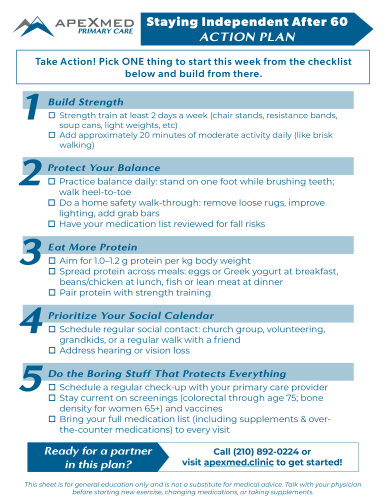
You don’t need to overhaul your life this week. Pick one thing — two strength sessions, protein at breakfast, a walk with a friend — and build from there.
Download our FREE Staying Independent After 60 Action Plan!
References
1 U.S. Department of Health and Human Services. Physical Activity Guidelines for Americans, 2nd Edition. — https://odphp.health.gov/sites/default/files/2019-09/Physical_Activity_Guidelines_2nd_edition.pdf
2 Centers for Disease Control and Prevention. Physical Activity for Older Adults. — https://www.cdc.gov/physical-activity-basics/adding-older-adults/index.html
3 Liu CJ, Latham NK. Progressive Resistance Strength Training for Improving Physical Function in Older Adults. Cochrane Database of Systematic Reviews. — https://www.cochrane.org/evidence/CD002759_progressive-resistance-strength-training-improving-physical-function-older-adults
4 Centers for Disease Control and Prevention. Facts About Falls. — https://www.cdc.gov/falls/data-research/facts-stats/index.html
5 U.S. Preventive Services Task Force (2024). Falls Prevention in Community-Dwelling Older Adults: Interventions. — https://www.uspreventiveservicestaskforce.org/uspstf/recommendation/falls-prevention-community-dwelling-older-adults-interventions
6 Bauer J, et al. (PROT-AGE Study Group). Evidence-Based Recommendations for Optimal Dietary Protein Intake in Older People. J Am Med Dir Assoc. — https://pubmed.ncbi.nlm.nih.gov/23867520/
7 Administration for Community Living. Nutrition Needs for Older Adults: Protein. — https://acl.gov/sites/default/files/nutrition/Nutrition-Needs_Protein_FINAL-2.18.20_508.pdf
8 Livingston G, et al. Dementia Prevention, Intervention, and Care: 2024 Report of the Lancet Standing Commission. The Lancet. — https://www.thelancet.com/commissions-do/dementia-prevention-intervention-and-care
9 National Institute on Aging. Social Isolation, Loneliness in Older People Pose Health Risks. — https://www.nia.nih.gov/news/social-isolation-loneliness-older-people-pose-health-risks
10 U.S. Preventive Services Task Force. Colorectal Cancer: Screening. — https://www.uspreventiveservicestaskforce.org/uspstf/recommendation/colorectal-cancer-screening
11 U.S. Preventive Services Task Force. Osteoporosis to Prevent Fractures: Screening. — https://www.uspreventiveservicestaskforce.org/uspstf/recommendation/osteoporosis-screening
Note: This article is for general education and isn’t a substitute for medical advice. Please talk to your physician before starting a new exercise regimen, taking supplements, or changing your medications.